Key takeaways
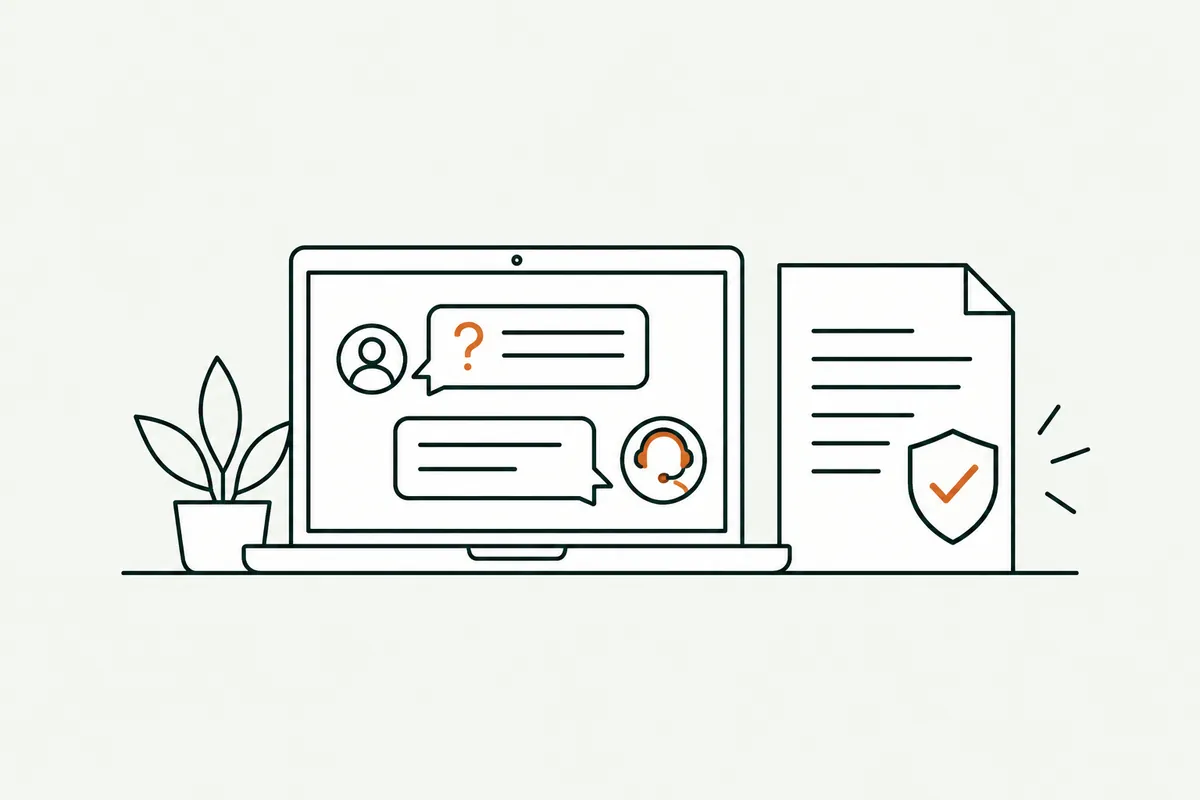
- Since August 2, 2026, a customer service chatbot must disclose that it’s an AI, clearly and from the start of the conversation (Article 50 of the EU AI Act). The July 2026 Digital Omnibus didn’t postpone this rule.
- A customer service chatbot isn’t a high-risk system: the EU AI Act doesn’t require human oversight for it. But you’re liable for what it says, and the GDPR applies as soon as it collects a name or an email address.
- A good chatbot answers from your documents, cites its source, hands off to a person at the slightest doubt, keeps a log, and gets measured. It never promises prices, lead times, or refunds.
AI in customer service does one thing very well: answering the questions that come up every day (lead times, shipping, warranties, order tracking) from your own documents, even when your team is busy. Everything else, it should leave to a person: disputes, goodwill gestures, unhappy customers. And since August 2, 2026, the EU AI Act has set one simple requirement for it: tell customers clearly, from the very start, that they’re talking to an AI.
I build chatbots and assistants plugged into small businesses’ documents and software. Here’s what I put in place, what I refuse to do, and what the EU AI Act’s chatbot requirements really are as of this writing. This article isn’t legal advice: it’s a practitioner’s reading. If your use case is sensitive, have a lawyer review it.
What can AI do in customer service, and what should it leave to a person?
At a small business, a good share of customer service requests look alike. The answer already exists somewhere: in your terms and conditions, your product pages, your ERP, or your delivery tracking tool. That’s where AI saves your team time, and where your customers get an instant answer.
| Request | AI can answer on its own | Hand off to a person |
|---|---|---|
| Delivery time, shipping costs | Yes, from your terms | If the customer disputes a delay |
| Where’s my order? | Yes, if it reads your ERP or the carrier’s tracking | If the order is stuck or can’t be found |
| Warranty, return, exchange | State the written rule | Any exception, any goodwill gesture |
| Technical question about a product | Yes, if the manual or product page has the answer | Troubleshooting, safety risk |
| Complaint, dispute, angry customer | No: acknowledge and pass it on | Always |
| Price, discount, quote | List prices only | Any negotiation |
The demo on my site works the same way: lead times, shipping, warranties, the tool answers. At the slightest doubt, it hands off to the team. In the demo’s (fictional) example, Alice from customer service picks up the conversation.
You get two settings, chosen task by task. Either the assistant drafts the reply and a person approves it before it goes out: that’s the right way to start for emails and form requests. Or, once its replies have proven themselves on a given type of question, it answers on its own, and anything outside the rules goes back to your team. The choice is yours, and you can switch in one click.
What makes a good AI customer service chatbot?
I judge a customer service chatbot on five points. None of them is optional.
- It answers from your documents. Terms and conditions, product pages, manuals, FAQs, ERP data: it doesn’t draw on its general knowledge. That’s the idea behind an AI chatbot for your documents.
- It cites its source. “According to our delivery terms, section 4…” The customer can check, and so can your team.
- It hands off. A “Talk to a person” button that’s always visible, and an automatic handoff when it doesn’t know, when the request falls outside its scope, or when tempers rise. The customer doesn’t have to repeat everything: the person gets the history.
- It keeps a log. Every conversation can be reviewed, along with the source used, to correct an answer, improve the documents, and respond to a customer who disputes something.
- It gets measured. Questions handled on its own, handoffs to a person, corrected answers: without these numbers, there’s no way to tell whether it’s helping customers or annoying them.
The same reasoning applies on the phone: an AI voice agent that picks up when no one’s available follows the same rules, and I break down its costs in the article on AI receptionist cost.
Key point A customer service chatbot that answers everything is a risk. One that answers accurately within a written scope, and hands off everything else, is a tool.
How much does customer service AI cost?
There’s no single price: it all depends on the route you choose. Three cost items always come up.
| Cost item | Off-the-shelf platform | Custom chatbot |
|---|---|---|
| Setup | Configuration, document import | Build and connection to your software, at a fixed price set upfront |
| Subscription | Per agent seat, every month | Hosting, often modest |
| AI usage | Often billed per conversation or per resolution | Language model usage, paid directly to the provider |
| Data and code | With the vendor | Accounts and code in your name |
A public benchmark: Intercom charges $0.99 per “outcome” (a resolved request or a completed action) for its AI agent, Fin, on top of the seats for its platform, at $29 to $132 a month depending on the plan (prices checked October 9, 2026). That model works for modest volumes. At thousands of requests a month, the bill grows with the volume.
Custom-built makes sense when the chatbot needs to read your software (orders, inventory, delivery tracking) or when you want to keep control of your data. I don’t publish prices on this site: the amount is set and put in writing after our first conversation, based on the scope.
What are the EU AI Act chatbot requirements for customer service?
The EU AI Act is Regulation (EU) 2024/1689, in force since August 1, 2024, and applied in stages. In July 2026, the Digital Omnibus on AI (Regulation (EU) 2026/1744 of July 8, 2026, published July 24, in force July 27) changed its timeline. Here’s what applies to a customer service chatbot.
| Requirement | Article | Applies from | What to do |
|---|---|---|---|
| Disclose that it’s an AI | 50(1) and 50(5) | August 2, 2026 | Clear notice from the start of the conversation |
| Mark generated content (machine-readable format) | 50(2) | December 2, 2026, for systems already on the market before August 2, 2026 | Mostly up to the model providers |
| Promote AI literacy among staff | 4 | February 2, 2025, relaxed in July 2026 | Train the people who monitor and correct the chatbot |
| Human oversight | 14 | December 2, 2027, high-risk only | Nothing mandatory for a customer service chatbot |
Chatbot disclosure requirements: saying it’s an AI
Article 50 requires systems that interact with people to be designed so those people know they’re dealing with an AI: clearly, no later than the first interaction, and in line with accessibility rules. There’s an exception when it’s “obvious.” The guidelines the European Commission adopted on July 20, 2026, reserve it for cases where almost no doubt remains, and they specifically name helpdesk chatbots among the examples where the obligation applies.
These guidelines give useful examples. A written notice at the top of the conversation, such as “You are interacting with an AI system,” supplemented if needed by a label that stays visible throughout. On the phone, a spoken sentence right at the start. And they consider these insufficient: a notice buried in the terms and conditions, a vague “assistant” with no further detail, a photo or a human tone that keeps the doubt alive. They also require the system to say what it is when asked, and recommend reminders in more sensitive contexts, including complaint handling.
Provider or deployer: who carries the obligation?
The disclosure duty falls on the provider, the party that puts the system into service under its own name. With an off-the-shelf platform, that’s in principle the vendor: check that the notice is actually displayed and that no setting has made it disappear. The guidelines specify that a company that develops a chatbot for its own use and puts it into service under its own name is a provider. For a chatbot custom-built in your name, that’s probably your situation: have a lawyer confirm it if the stakes are high. In practice, I add the notice in every case: it’s your website and your customers.
Training your team: Article 4, relaxed
Article 4 has applied since February 2, 2025. The omnibus rewrote it: providers and deployers “take measures to promote the development” of their staff’s AI literacy, rather than having to guarantee a given level. In practice, the person who reviews the log and corrects the answers needs to know how the tool works and where it can go wrong.
Human oversight isn’t required for a customer service chatbot
Article 14 requires human oversight only for high-risk systems, uses listed in Annex III: recruitment, access to credit, education, biometrics, access to essential services. Answering questions about delivery times isn’t one of them. And even for high-risk systems, these rules will only apply from December 2, 2027 (Annex III) and August 2, 2028 (Annex I). Handing off to a person remains good practice, not an EU AI Act obligation.
Penalties and relief for small businesses
Breaching Article 50 can cost up to €15 million or 3% of worldwide annual revenue. For a small or midsize business, the lower of the two amounts applies (Article 99). The €35 million or 7% figure targets prohibited practices, not a chatbot. The omnibus also gives small and midsize businesses priority access to regulatory sandboxes. In France, the authorities in charge of enforcement were still being designated as of this writing.
Key point The omnibus postponed the high-risk rules, not customer disclosure: your chatbot has had to say it’s an AI since August 2, 2026. The rest of the EU AI Act barely affects it.
Who is liable for what the chatbot says?
Your company, in your customers’ eyes. In February 2024, a British Columbia tribunal found Air Canada liable: its chatbot had described a refund policy that didn’t exist, and the argument that the chatbot was a separate entity, responsible for its own statements, was rejected (decision 2024 BCCRT 149). It isn’t a French ruling, but the logic holds everywhere: to the customer, the chatbot is you.
Hence two rules I always apply. The chatbot never promises a price, a lead time, or a refund that isn’t in your documents. And at the slightest doubt, it passes the request on instead of improvising.
The GDPR comes on top of the EU AI Act. As soon as a customer leaves a name, an email address, an order number, or the details of their request, you’re processing personal data: you must inform them at the point of collection (Article 13), set a retention period for the log, and sign a data processing agreement with every provider that handles this data for you, chatbot vendor and model provider included (Article 28). For your team’s use of ChatGPT or Claude, see the article on shadow AI and AI policies.
If the legal side is holding you back, you’re not alone: according to Insee, France’s national statistics office, 38% of companies that don’t use AI cite a lack of clarity about its legal consequences, and 48% of those with 50 to 249 employees.
What should you check before a customer service chatbot goes live?
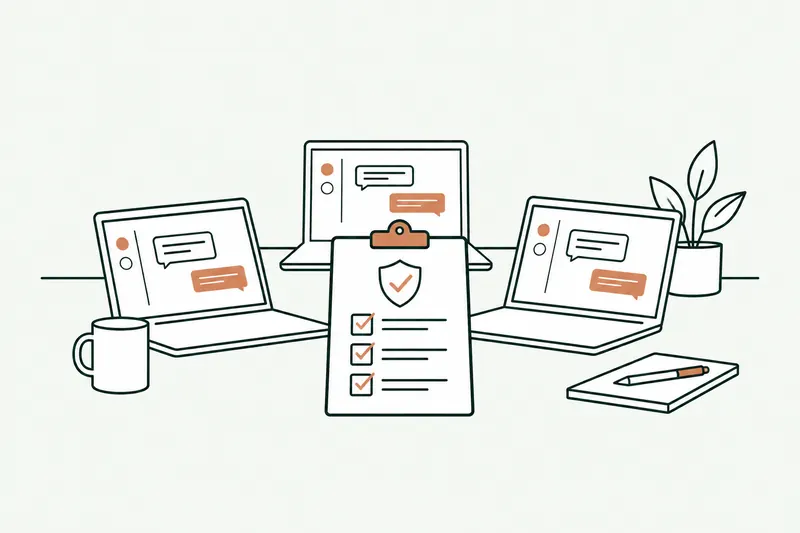
Here’s the checklist I apply to every website chatbot. It isn’t an official standard: it’s a practice that covers Article 50 and the questions that come right after it.
- The notice in the very first message: “You’re chatting with an AI assistant.” Easy to read, high-contrast, read aloud by screen readers, plus an “AI” label visible throughout the conversation.
- A name that doesn’t mislead: “Martin SA Assistant” rather than a first name and a photo of a person.
- An honest answer when the customer asks, “Am I talking to a bot?”
- A written scope: the topics covered, the documents used, the topics always handed off.
- A “Talk to a person” button that’s always visible, and an automatic handoff, with the history.
- The source cited in every factual answer.
- The GDPR notice at the moment the customer gives their contact details.
- A log you can review, with a set retention period.
- A one-page memo: the use case, each party’s role (provider, deployer), why it isn’t a high-risk use, the notices in place.
- A named person who reviews the log every week and updates the documents.
For an online store, I add a review of the answers on returns and refunds before every sales season: that’s when questions surge. See also the e-commerce page.
What I don’t recommend
- A chatbot that answers everything. The broader the scope, the more it improvises. I’d rather have ten topics handled well than a hundred handled roughly.
- A chatbot sold as “EU AI Act certified.” No such label exists for a customer service chatbot. A serious provider walks you through the measures in place. They don’t sell you a stamp.
- Believing Article 50 was postponed. The omnibus postponed the high-risk rules and granted extra time only for machine-marking content. Customer disclosure has applied since August 2, 2026.
- Believing the EU AI Act requires a person behind every answer. Not true for a customer service chatbot. The level of review is your call, question by question.
- Hiding that it’s an AI to seem more human. It goes against the regulation, and it’s the surest way to lose a customer’s trust the day they find out.
- Letting it talk money. Discounts, refunds, penalties: a person should decide.
Torn between a chatbot, an AI agent, or a simple automation for your customer service? I compare all three in AI agent vs. chatbot vs. automation: which one to choose.
Sources
- Regulation (EU) 2024/1689 on artificial intelligence (AI Act), EUR-Lex
- Regulation (EU) 2026/1744 of July 8, 2026 (Digital Omnibus on AI), EUR-Lex
- Guidelines on the transparency obligations for providers and deployers of AI systems (Article 50), C(2026) 5054 final, European Commission, July 20, 2026
- AI Act implementation timeline, AI Act Service Desk, European Commission
- Article 50: Transparency obligations (consolidated text), artificialintelligenceact.eu
- Article 14: Human oversight (consolidated text), artificialintelligenceact.eu
- Article 99: Penalties (consolidated text), artificialintelligenceact.eu
- General Data Protection Regulation (EU) 2016/679, EUR-Lex
- BC Tribunal confirms companies remain liable for information provided by AI chatbot, American Bar Association, February 2024
- Insee Première No. 2120: AI use in businesses (in French), Insee, July 21, 2026
- Intercom pricing (Fin AI Agent), checked October 9, 2026

Loïc Legrand
AI developer and integrator in Paris, founder of DigitalCX. Eight years of web development and design; he builds AI tools plugged into the software small businesses already use.