Key takeaways
- The Diagnostic Data IA is 8 days of a Bpifrance-approved expert’s time over 3 months at most, for a quote capped at €10,000 before tax and 40% subsidized: €6,000 before tax is left for you to pay.
- You need 10 to 2,000 employees, at least €1M in revenue over 12 months, and more than a year in business. Below that: the Autodiag IA (which costs nothing), regional grants, EDIHs, and chambers of commerce.
- The Diag delivers ranked use cases and an action plan, not a working tool. What comes next, a prototype and then go-live, is separate work, with a separate budget.
The Diagnostic Data IA (or “Diag Data IA”) is a consulting program from Bpifrance, France’s public investment bank: an approved expert spends 8 days with your company, over 3 months at most, to identify and rank artificial intelligence use cases. The quote is capped at €10,000 before tax and the French government covers 40% of it: you have €6,000 before tax left to pay. It’s open to small and midsize businesses in France (PMEs and ETIs) with 10 to 2,000 employees, at least €1M in revenue, and more than a year in business.
I don’t sell this diagnostic: I’m not a Bpifrance-approved expert. I build AI tools plugged into small businesses’ software, and I meet business owners before, during, or after their Diag. This article gives an honest comparison of the paths available, Bpifrance AI funding and other public grants included, and answers the question that comes right after: once you have the list of use cases, who turns it into a tool that actually runs?
How much does the Bpifrance Diag Data IA cost, and how much is left to pay?
Bpifrance’s fact sheet, rechecked on October 9, 2026, is clear: the maximum quote is €10,000 before tax, and what’s left to pay is €6,000 before tax after a 40% subsidy, funded by France 2030, the government’s investment program, under the “Osez l’IA” plan. So you do pay for the diagnostic. Spread over the 8 days of work, that’s €1,250 before tax per expert day, €750 of which you pay.
| Diag Data IA | What Bpifrance’s fact sheet says |
|---|---|
| Price | Quote capped at €10,000 before tax |
| Subsidy | 40%, from France 2030 (“Osez l’IA” plan) |
| Left for you to pay | €6,000 before tax |
| Duration | 8 days of work, spread over 3 months at most |
| Who does the work | A data science and AI expert approved by Bpifrance |
| How to apply | Online on Bpifrance’s Diag platform, or through your Bpifrance account manager |
Be wary of the figures going around. Many pages still show the old terms (€13,000 before tax, 42% covered), others a 50% or 80% rate. Even a page on the France Num portal, updated in June 2026, still gives a range of €3,900 to €13,000 before tax with 80% covered, which no longer matches Bpifrance’s current fact sheet. Before you budget, Bpifrance’s fact sheet is the one that counts.
Key point Diagnostic Data IA: €10,000 before tax at most, 40% covered, €6,000 before tax to pay, 8 expert days over 3 months. Check any other figure at the source.
Is my company eligible for the Diag Data IA?
Bpifrance reserves the program for companies that tick all of these boxes:
- an independent small or midsize business (PME or ETI) with 10 to 2,000 employees (full-time equivalents), whether or not it’s a Bpifrance client;
- at least €1M in revenue over a 12-month fiscal year;
- more than a year in business, registered with the French trade and companies register (RCS);
- based in France, overseas territories included, in any sector eligible under Bpifrance’s policy;
- not a company in difficulty as defined by EU regulations.
So an 8-person company, or a 30-person company with €800,000 in revenue, doesn’t qualify. That’s no tragedy: other doors are open, and I go through them below.
The “Osez l’IA” plan, launched in July 2025, aims for AI use in 80% of small and midsize businesses by 2030. That’s a long way off: according to Insee, France’s national statistics office, 18% of companies with 10 or more employees were using AI in early 2025, and 71% of those that don’t use it say they see “no use” for it. As of September 3, 2026, France’s Directorate General for Enterprise (DGE) counted 70 Diag Data IA projects underway and announced 1,000 for the plan’s next phase.
What does the Diagnostic Data IA deliver, and what does it leave out?
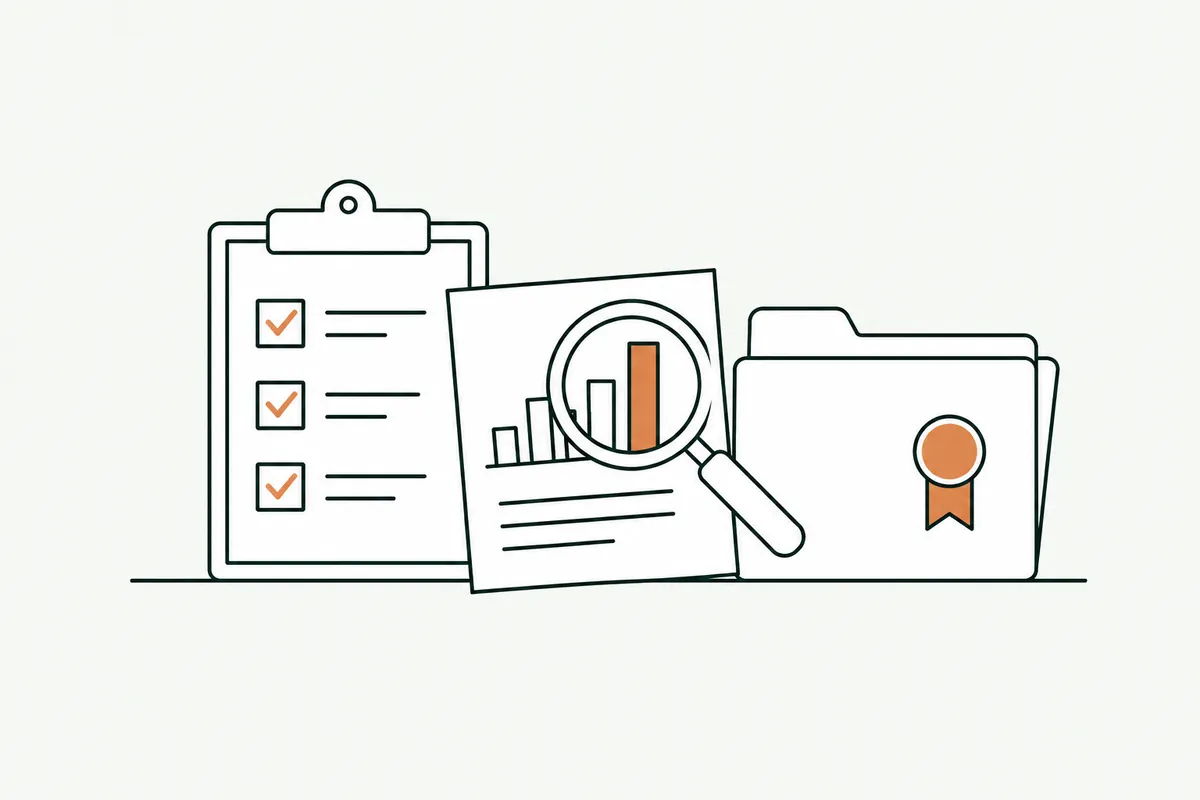
According to Bpifrance and France Num, the expert follows a standard four-step method:
- a technical and operational assessment, to gauge your data and AI maturity;
- identifying concrete use cases, suited to your context and your ambitions;
- ranking them by added value, with a first estimate of the cost, the possible return, and the impact on the organization, plus an outline of the strategy (off-the-shelf solution, custom build, or a mix);
- a roadmap and an action plan.
It’s useful, especially if you’re starting from scratch. In 2025, Bpifrance Le Lab found that 23% of small and midsize business leaders struggle to identify use cases, and that 57% have no AI strategy: the Diag meets exactly that need.
What it doesn’t deliver, however, is a tool. At the end, no order gets entered into your ERP on its own, and no call is handled any better. Nor does the Diag test the use case on your real data: the estimated gain remains an estimate. Building, connecting to your software, and going live are separate work, and the subsidy doesn’t cover them.
Key point The Diag Data IA tells you what to do and in what order. It doesn’t do it. Plan the budget and the provider for what comes next from day one.
What other AI grants can small businesses get in France in 2026?
The Diag isn’t the only program. Here are the ones I was able to check at the source, from the lightest to the most involved.
| Program | Who it’s for | What it costs | What you get |
|---|---|---|---|
| Autodiag IA (Bpifrance) | Any small or midsize business | €0, with a Bpifrance en Ligne account | 32 questions, 15 minutes, an instant maturity radar |
| AI ambassadors, chambers of commerce (CCI) | Any company | Awareness events | Workshops, first pointers, regional contacts |
| EDIHs (European Digital Innovation Hubs) | Companies already going digital | AI support funded at 50%, up to 80% in some regions | Depending on the hub: diagnostic, roadmap, trials |
| Diagnostic Data IA (Bpifrance) | 10 to 2,000 employees, €1M in revenue, over a year in business | €6,000 before tax after the 40% subsidy | Ranked use cases, action plan |
| Accélérateur IA (Bpifrance) | Over €8M in revenue, over 50 people, 3 years in business | 46% covered | 18 months: a 12-day diagnostic, then two 13-day modules |
| Regional grants | Depends on the region | Varies | Consulting, sometimes a first use case |
The “Osez l’IA” plan: awareness before investment
The government’s plan rests on three pillars: raising awareness, training, and support. In June 2026, the DGE counted 615 AI ambassadors across 20 regions and 13 sectors, and more than 35,000 companies reached in nine months. Bpifrance has opened a platform of examples, “Accélérez avec l’IA,” and the DGE publishes, with Hub France IA, a catalog of 88 providers of AI solutions suited to small and midsize businesses. It costs nothing and helps you get a sense of what’s possible, but it’s no substitute for a close look at your own processes.
The Autodiag IA: a first step that costs nothing
Offered by Bpifrance and promoted by France Num, the Autodiag IA takes 32 questions and 15 minutes. It covers your possible use cases, your team’s maturity, how digital your processes are, and how usable your data is. The result is instant, with a radar chart that shows where you stand compared with other business leaders. You’ll need a Bpifrance en Ligne account, which costs nothing to open. It’s the right first move for a company too small for the Diag.
The Accélérateur IA, for larger companies
For companies with more than €8M in revenue and 50 employees, and at least three years in business, Bpifrance offers an 18-month program: a 12-day, 360° diagnostic focused on AI, then two 13-day modules, 46% covered by France 2030. It comes in two versions, “Accélérateur IA” and “Accélérateur IA & Industrie.”
Regional grants and EDIHs
Each region has its own programs, and they change often. Example: in Provence-Alpes-Côte d’Azur, the “Mon assistant IA” program covers 100% of a consulting engagement (awareness, assessment, AI and data action plan, first use case) for small and midsize businesses more than a year old with at least two people working there, once per site, according to the fact sheets published in 2026. Confirm the terms with the Region. The 30 European Digital Innovation Hubs (EDIHs) also offer AI support, funded at 50% and up to 80% in some areas, according to France Num. France Num’s grant search engine remains the most reliable starting point.
Training: go through your OPCO
To train your team, your OPCO (the industry body that funds training in France) pays, under your sector’s rules, with a Qualiopi-certified training provider. You apply before the training starts. FNE-Formation, often mentioned, no longer takes new applications: the DREETS fact sheet set December 31, 2024, as the deadline for approvals.
Tax credits: the CII rather than the CIR
The innovation tax credit (CII), reserved for small and midsize businesses, has been 20% in mainland France since 2025, on spending to design prototypes or pilot installations of new products. The research tax credit (CIR) requires genuine research work, with a scientific or technical uncertainty to resolve. In my view, plugging a language model into your ERP generally doesn’t qualify: have your accountant check your case before you count on it in your budget.
Subsidized Diag Data IA or private AI audit: how do you choose?
The two approaches aren’t at odds. They just don’t answer quite the same question.
| Criterion | Diagnostic Data IA | Private AI audit (example: DigitalCX) |
|---|---|---|
| Duration | 8 days over 3 months at most | 10 days |
| Price | €6,000 before tax after the subsidy | Fixed price in writing before we start, credited toward the prototype if you continue |
| Eligibility | 10 to 2,000 employees, €1M in revenue, over a year in business | No size requirement |
| Starting point | Your data and AI maturity | The tasks that come back every week, measured in hours |
| At the end | Ranked use cases, action plan | Costed use cases, a review mode for each, a plan with price and deadline, then a prototype in 5 days |
| Who builds it next | Still to be found | The same person, if you want |
My honest advice: if you’re eligible and don’t know where to start, the Diag Data IA is a good starting point. €6,000 for eight days of an approved expert’s time is reasonable. If you’re not eligible, if you already know which task costs you the most, or if you want the diagnostic to lead to a working tool, an AI audit focused on execution is more direct.
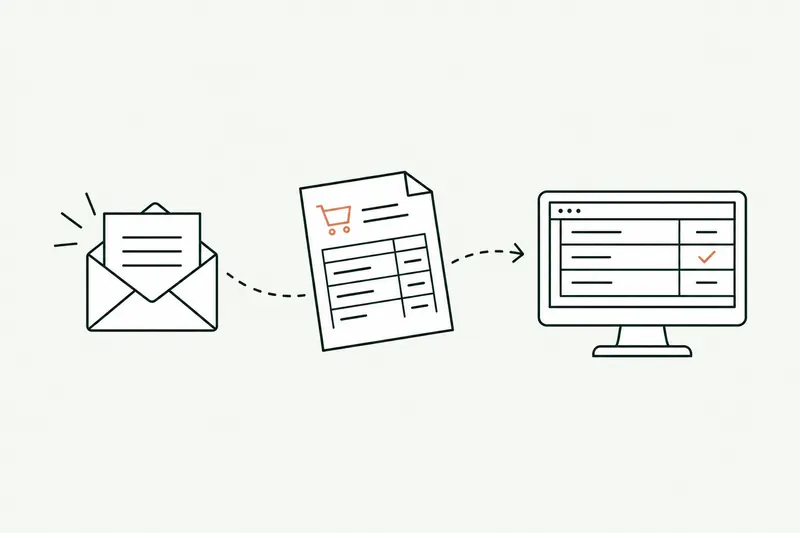
And sometimes you need neither. When the need is clear (for example, “our sales reps retype 50 purchase orders a day into the ERP”), you can go straight to a prototype. Another diagnostic wouldn’t teach you anything you don’t already know.
After the Diagnostic Data IA: how do you get a first tool up and running?
This is where many projects stall. The report gets filed away, the expert has moved on, and no one in-house has time to launch the next step. Here’s how I go about it when a business owner comes to me with their Diag report.
- Pick a single use case. The first on the list isn’t always the right one: I prefer the one that comes back every week, whose gain is measured in hours, and whose data is accessible (an API, an export, an email inbox).
- Show it before building it. On the first call, I show you a tool that handles this use case on sample data. You see the result before committing to anything.
- Test it on your real data. A 5-day prototype, plugged into your software. That’s where the Diag’s estimate becomes a measurement.
- Set the review level task by task. At first, someone on your team approves what the tool prepares. Once the task has proven itself, it can switch to autonomous mode. Anything outside the rules always goes back to a person, and you can take back control in one click.
- Go live on a written date, with the accounts and the code in your name.
Depending on the use cases chosen, the next step is business process automation (orders, quotes, invoices) or AI integration into your software. To estimate the build budget, I explain the orders of magnitude in the article on custom software development cost, and the difference between types of tools in AI agent vs. chatbot vs. automation.
The industries where a Diag report turns into a tool fastest: wholesale and distribution and manufacturing, where the same tasks come back every day (orders, purchasing, follow-ups, reports).
Pitfalls to avoid with AI grants
- Budgeting with outdated terms. €13,000 and 42%, 50%, or 80%: these aren’t the current terms of the Diagnostic Data IA. Reread Bpifrance’s fact sheet on the day you apply.
- Committing spending before approval. For most grants, regional and OPCO alike, spending committed before approval can no longer be funded. Wait for the written answer before accepting a quote.
- Confusing diagnostic and training. The Diag identifies use cases. It doesn’t train your team. A generative AI course won’t tell you which tasks to automate.
- Thinking the Diag funds what comes next. The subsidy covers the 8 days of consulting. The prototype and the go-live are funded separately.
- Choosing a provider on the promise of a grant. No provider can promise you eligibility or an amount: only the body that pays the grant decides.
- Letting the report gather dust. Set the date of the first prototype the day you receive the report, or it will end up on the shelf with the others.
One last point of transparency: I’m neither an approved expert nor a Bpifrance partner, I don’t carry out the Diag Data IA, and I don’t put together grant applications. I build what comes after, and I say so on the first call. If your team already uses ChatGPT with no framework in place, also start by reading the article on shadow AI and AI policies: it’s often the first question a diagnostic raises.
Sources
- Diag Data IA, offer catalog, Bpifrance (in French, fact sheet reread October 9, 2026)
- Diag Data IA: tailored support to make the most of your data with AI, France Num (in French), updated June 25, 2026
- Strengthening the national “Osez l’IA” plan, Directorate General for Enterprise (in French), June 17, 2026
- One year of the “Osez l’IA” plan: a positive first review and a new phase, Directorate General for Enterprise (in French), September 3, 2026
- The national “Osez l’IA” plan, Directorate General for Enterprise (in French), updated September 28, 2026
- Autodiag IA: assess your company’s ability to run AI projects, France Num (in French), updated June 19, 2026
- Financial aid to help small businesses use AI, France Num (in French), updated June 19, 2026
- Mon assistant IA, Région Sud (les-aides.fr fact sheet, in French, July 2026)
- FNE-Formation, DREETS fact sheet (les-aides.fr, in French)
- Innovation tax credit, French Ministry of the Economy (in French)
- Insee Première No. 2120, AI use in businesses (in French), July 21, 2026
- AI in French small and midsize businesses: a quiet revolution, Bpifrance Le Lab (in French), June 4, 2025

Loïc Legrand
AI developer and integrator in Paris, founder of DigitalCX. Eight years of web development and design; he builds AI tools plugged into the software small businesses already use.